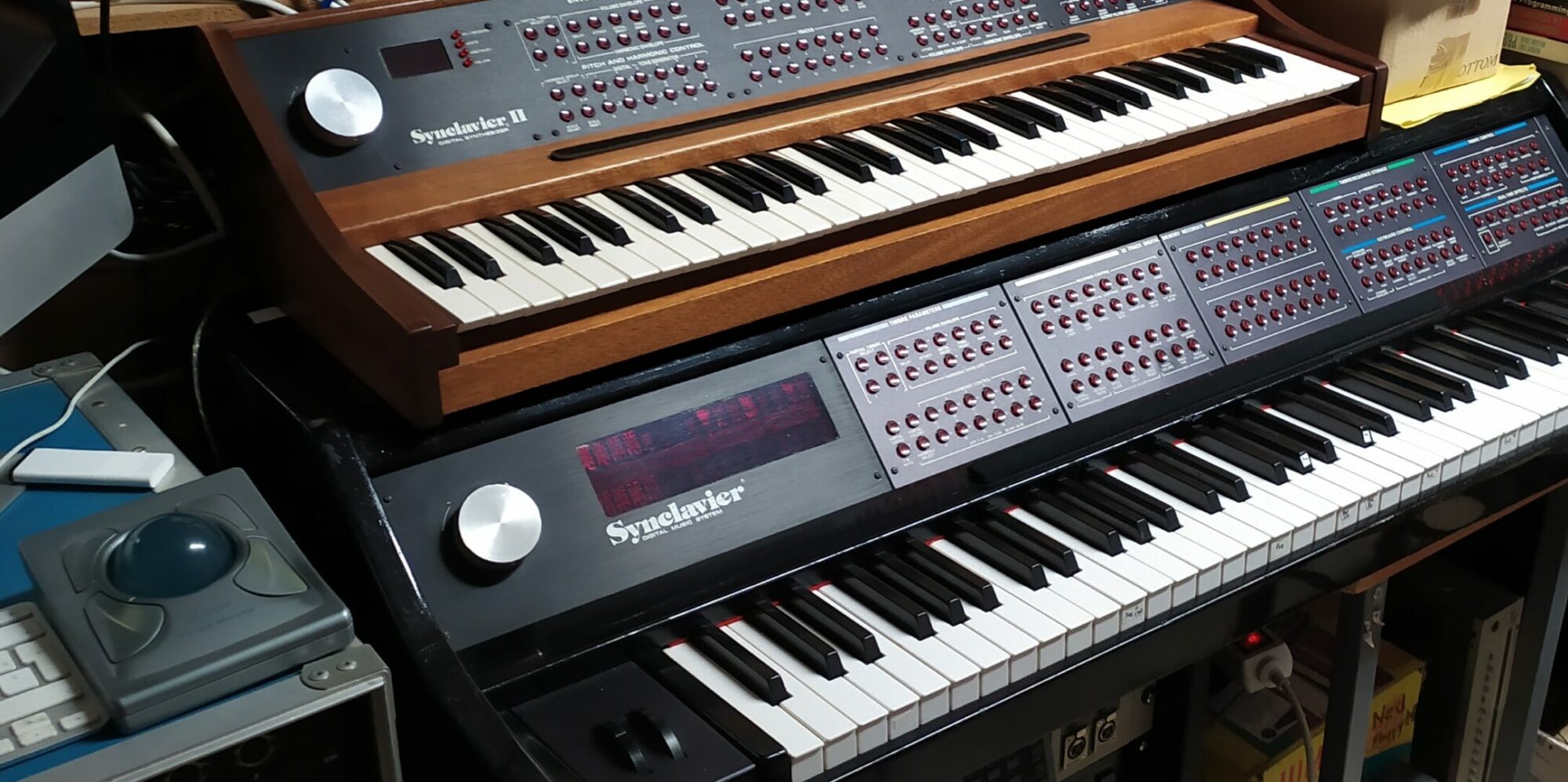
I offer a range of specialised software programmes for synthesisers; currently for NED and Fairlight, but soon for other brands (E-mu, Kurzweil, Akai). Generally speaking, the programmes I offer allow you to work with discs and files, as well as manage the user interface.
I make every effort to develop my programmes so that they can be ported to the three main operating systems in use today, namely: Windows (10 and 11), macOS (10.13 and later) and Linux (Debian 13 and derivatives). I support all I/O interfaces compatible with these systems.
For the time being, I have set the release date for all these programmes for the end of 2026.
For the New England Digital Synclavier, I recommend two software programmes :
TEKTROmulator (macOS, Windows 10/11, Linux) — scheduled for release in late 2026
TeKtromulator is a software application designed for the emulation, analysis, and preservation of the terminals used with New England Digital / Synclavier® systems. It provides both VTxxx-style text terminal services and support for the graphical primitives defined by the Tektronix 40xx standard, allowing it to emulate historical terminals such as the DEC VT100, DEC VT640, and Pericom Monterey MG600.
The software makes it possible to replace a physical terminal with a modern software-based solution capable of receiving, interpreting, and displaying the text and graphics data streams generated by the original machine. It can therefore reproduce text screens, tables, vector graphics, graphical pages, and diagnostic displays produced by Synclavier systems, while also providing modern display, capture, and analysis tools.
TeKtromulator can use any available RS-232 serial port to communicate with a Synclavier® digital audio system. It supports modern serial interfaces, including both branded and generic USB-to-RS-232 adapters, provided that they are correctly recognized by the operating system. Serial communication can be configured according to the requirements of the connected machine, with transmission speeds of up to 38,400 baud.
As a result, TeKtromulator can operate with all generations of Synclavier systems that use this type of display and serial communication, from the earliest Synclavier I and Synclavier II systems to the more recent Synclavier 9600 family. It therefore makes it possible to connect a modern computer to a real Synclavier without relying on an original terminal that may now be rare, fragile, or difficult to maintain.
The software can also capture RX/TX communications, record complete sessions, replay captured data, compare system behaviour, and analyse the control sequences sent to the terminal. This approach facilitates the diagnosis of display problems, the understanding of the protocols involved, the verification of the actual behaviour of historical software, and the preservation of sessions as reusable data files.
TeKtromulator is not limited to terminal emulation. It also supports text files in the NED format, with conversion functions between the Synclavier environment and modern computers. It therefore becomes possible to recover, view, convert, prepare, or transfer text files back to a Synclavier system, while taking into account differences in character encoding, line endings, and data representation between historical NED media and the text formats currently used on Windows, macOS, and Linux.
TeKtromulator is therefore simultaneously a VTxxx terminal emulator, a Tektronix 40xx graphics interpreter, a serial diagnostic tool, a terminal data-stream analyser, and a conversion tool for NED text files. It is intended to restore historical displays, test legacy software, document display protocols, verify RS-232 communications, and progressively replace the physical terminals originally used with Synclavier systems.
More broadly, the project aims to provide a modern environment for working with real Synclavier systems or with data captures obtained from these machines. It makes it possible to understand precisely what the Synclavier sends to the terminal, identify display anomalies, preserve communications, replay sessions, and simplify the maintenance, troubleshooting, or restoration of historical configurations.
The planned architecture is clean and modular, with a clear separation between the terminal emulation engine, the VTxxx sequence parser, the Tektronix 40xx graphics interpreter, RS-232 data-stream management, NED text-file conversion tools, and the graphical user interface. The long-term objective is to provide a modern, cross-platform version built with JUCE, running on Windows, macOS, and Linux.
Many features are still under development, but the objective is clear: to make TeKtromulator a comprehensive tool for displaying, analysing, converting, testing, and preserving Synclavier® environments based on historical text and graphics terminals.

NEDExplorer (macOS, Windows 10/11, Linux) — scheduled for release in late 2026
NEDExplorer is a software application dedicated to the exploration, manipulation, and preservation of New England Digital / Synclavier media. It makes it possible to work directly with NED disk images in order to browse the catalogues, subcatalogues, and files they contain, using standard file-management operations such as copy and paste, import and export, conversion, editing, creation, deletion, and renaming whenever the format permits.
At disk-image level, NEDExplorer can open and analyse existing media, display their internal structure, inspect sector allocation, and identify free or occupied areas, fragmented files, reserved sizes, and the amount of space actually used. It can also test suspicious images, generate structural reports, and prepare or perform catalogue defragmentation operations.
The software provides two complementary ways of reading media contents: directly, sector by sector, for low-level analysis, or file by file, for easier access to musical, textual, or audio data. This dual approach makes it suitable for diagnostics, data recovery, archiving, and conversion.
NEDExplorer also goes beyond the capabilities of a conventional file explorer. It progressively integrates specialised functions for Synclavier-specific file types, including the display and editing of TEXT files, analysis of SOUND files, waveform visualisation, WAV export, mono and stereo support, and preparation for audio playback directly within the application. Other internal formats related to sounds, banks, sequences, timbres, or system data may also be analysed and edited as development progresses.
The objective is to provide a modern tool capable of understanding historical Synclavier media, documenting them, repairing them whenever possible, extracting their contents, and modifying them cleanly and safely. Many advanced features are still under development, but NEDExplorer is intended to become a complete environment for restoring, exploring, converting, and editing New England Digital data on modern computers.


For the Fairlight CMI I, II, IIx and CMI III, as well as the MFX I, II and III:
FairlightExplorer (macOS, Windows 10/11, Linux) — scheduled for release in late 2026
FairlightExplorer is a software application designed for the exploration, manipulation, conversion, and preservation of media used by Fairlight CMI systems. It makes it possible to work directly with disk and floppy-disk images from the different generations of Fairlight machines, allowing their contents to be read, analysed, modified, and extracted on a modern computer.
The software provides the standard operations expected for managing files stored on Fairlight media: copy and paste, import and export, conversion, editing, creation, deletion, and renaming. It aims to support the main environments and formats found on these machines, including MDOS, QDOS, and OS-9, as well as the associated disk and floppy-disk image formats, such as IMD, HFE, IMG, and both raw and encapsulated formats.
FairlightExplorer is not limited to opening a disk image and extracting its files. It can also display the internal structure of the media, including catalogues, subcatalogues, tracks, sectors, used and free blocks, fragmented files, reserved sizes, actual storage usage, and the logical organisation of the medium. Users can therefore read data sector by sector for low-level analysis, or directly file by file for easier access to musical, audio, text, or system content.
At disk- and floppy-image level, the software can open existing media, create new images, test suspicious images, identify possible inconsistencies, and prepare or perform defragmentation operations whenever the format permits. This makes it possible to diagnose the condition of a medium, understand its structure, recover data, or prepare a clean image that can be used by a real Fairlight machine or within an emulation environment.
FairlightExplorer is also designed as a conversion tool. It can extract Fairlight content into formats that can be used on modern systems, for example to recover sound files, voices, sequences, text files, or other specialised data. The objective is to simplify the transfer of data between historical media and current computers while preserving, as far as possible, the original structure of the files and Fairlight file systems.
The software is intended to evolve far beyond the capabilities of a conventional disk explorer. It is designed to integrate specialised editing functions for Fairlight internal formats, including voice files, sound parameters, configuration files, sequences, music pages, scripts, text files, and other data specific to the different generations of CMI systems. The objective is therefore not merely to read or extract files, but also to understand, modify, convert, and correctly reinsert them into usable disk images.
FairlightExplorer is intended for users of historical Fairlight machines, musicians, restorers, collectors, archivists, and developers working on the preservation or emulation of these systems. It can be used to back up old media, recover content that may otherwise be difficult to access, compare disk images, analyse suspicious floppy disks, and precisely document the internal organisation of their data.
More broadly, FairlightExplorer is intended to provide a modern working environment for Fairlight CMI media. It should make it possible to create, test, repair, explore, convert, and edit disk images and their associated files, while providing a clear interface suited to modern computers.
The planned architecture is clean and modular, with a clear separation between the format-analysis engine, disk-image management, file converters, specialised editing tools, and the graphical user interface. The objective is to provide a modern, cross-platform version built with JUCE, running on Windows, macOS, and Linux.
Many advanced features are still under development, including complete editing support for internal formats, in-depth sound and sequence conversion, detailed analysis of disk structures, advanced fragmentation management, and improvements to the diagnostic tools. However, the objective is clear: to make FairlightExplorer a comprehensive tool for restoring, exploring, converting, modifying, and preserving the media and files used by Fairlight CMI systems.


You must be logged in to post a comment.